All Posts
The Missoun Reference Architecture: Connecting Engineering, Marketing Sales, and Operations
Manufacturers of configurable products face a common challenge: bridging the gap between engineering complexity and sales simplicity.
Behind every personalized product lies a network of systems that must work in harmony — from design and pricing to production and delivery.
At Missoun, we’ve built the framework that makes this possible: the Missoun Reference Architecture.
It’s a unified model that connects PLM, CPQ, ERP, and CRM — ensuring that what’s engineered is exactly what’s sold, priced, and produced.
A Connected Ecosystem
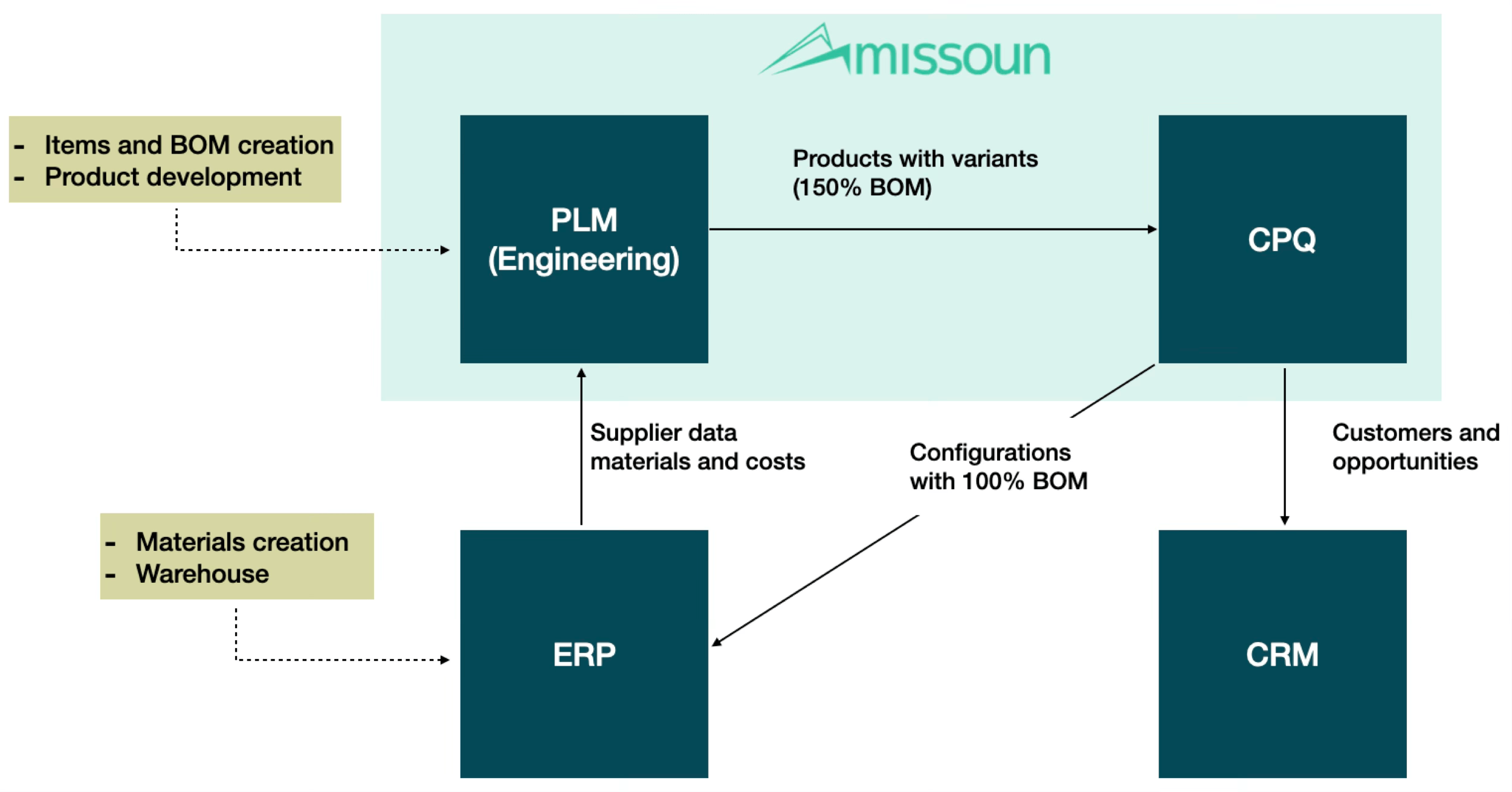
The Missoun Reference Architecture defines how core enterprise systems interact to support the full Configure-to-Order (CTO) process:
- PLM (Product Lifecycle Management) – the source of truth for product structures, variants, and engineering data (BOM 150%).
- CPQ (Configure, Price, Quote) – enables dynamic configuration, rule-based pricing, BOM resolution, and quotation management.
- ERP (Enterprise Resource Planning) – manages materials, suppliers, inventory, costs, and production orders.
- CRM (Customer Relationship Management) – tracks customer data, opportunities, and sales performance.
Together, they form a digital backbone that eliminates silos, ensures data consistency, and accelerates time-to-market.
How Data Flows Through the System
The architecture defines clear, bidirectional data flows:
- ERP → PLM: Supplier, material, and cost data flow from ERP to keep engineering information current.
- PLM → CPQ: Engineering publishes product definitions and configuration rules to CPQ.
- CPQ → ERP: Once the product is configured, CPQ sends the resolved BOM 100% for order creation and execution.
- CPQ ↔ CRM: Quotes, customers, and opportunities synchronize between CPQ and CRM for full sales visibility.
Every step is traceable — from initial product definition to a confirmed customer order — maintaining integrity across departments and systems.
A Common Language for Product Data
Missoun’s approach standardizes how data moves across the enterprise:
- Engineering items and BOMs are created in PLM, carrying the logic and structure needed for configuration.
- Supplier part numbers are created in ERP, ensuring accurate procurement and costing.
- A cross-reference mechanism keeps both worlds aligned, linking engineering codes, ERP item codes, and supplier part numbers in a single, traceable model.
- Monitoring costs and weight is accurately managed by PLM for each item, with and without an associated bill of materials.
This unified approach prevents duplication, simplifies integration, and provides a shared product language across engineering, sales, and operations.
Built for Modern Manufacturers
Missoun’s architecture was designed for the new generation of digital manufacturing businesses — those who build configurable, high-complexity products and need agility without losing control.
By adopting this architecture, manufacturers gain:
- Faster quote-to-order cycles and real-time configuration validation
- A single source of truth for product and pricing data
- Reduced errors in BOM transfer and order execution
- Seamless integration with existing ERP and CRM systems
The result: a truly connected organization where product definition, configuration, and fulfillment operate as one process.
Why It Matters
The future of manufacturing is connected, data-driven, and customer-centric.
The Missoun Reference Architecture provides the foundation — a scalable, cloud-native framework that brings engineering precision and commercial speed together in one ecosystem.
Transform your digital backbone
If your business relies on configuration, variants, or complex product data, Missoun can help you streamline how your systems work together.
Let’s connect your PLM, CPQ, ERP, and CRM — and turn product complexity into digital simplicity.
Book a demo or contact us at hello@missoun.com